Breast Shape & Size
Breast Shape & Size
"My breasts is saggy." Some breasts are too small or too heavy. Others are uneven, or they dropped after children or weight loss, and clothes never sit right afterwards. Most people who ask about their breasts have been thinking about it for years. They arrive with a specific sentence. They are too small for my frame. They are too heavy for my back. One is bigger than the other. Or they dropped after the children and never came back. Each of those is a different problem, and each has its own operation. The most common mistake is asking for the wrong one. Usually that is an implant for a breast that needs a lift.
Breast Shape & Size
Breast Shape & Size
"My breasts is saggy." Some breasts are too small or too heavy. Others are uneven, or they dropped after children or weight loss, and clothes never sit right afterwards. Most people who ask about their breasts have been thinking about it for years. They arrive with a specific sentence. They are too small for my frame. They are too heavy for my back. One is bigger than the other. Or they dropped after the children and never came back. Each of those is a different problem, and each has its own operation. The most common mistake is asking for the wrong one. Usually that is an implant for a breast that needs a lift.
WHAT CAUSES IT
Why it happens
Breast concerns come in four kinds, and each has its own operation. Telling these four apart is the point of an assessment. Breasts that look alike can have different causes, and the right operation follows the cause.
01
Too little volume
Breasts that never developed much, or that emptied after pregnancy or weight loss, in skin that is still firm.
02
Too much weight
Breasts heavy enough to cause neck, shoulder and back strain, bra-strap grooves and rashes in the fold.
03
A breast that has dropped
The skin has stretched and the tissue and nipple sit low, pointing down, with or without enough volume.
04
Two sides that differ
A difference in size, shape or nipple position that is normal in small degrees and distressing in larger ones.
WHAT ACTUALLY TREATS IT
What actually treats breast shape and size in Barrie
Four different breast concerns, four different operations, and the most common mistake is asking for the wrong one. Surgical and non-surgical treatment are both offered here, so the assessment decides the route rather than what happens to be available.
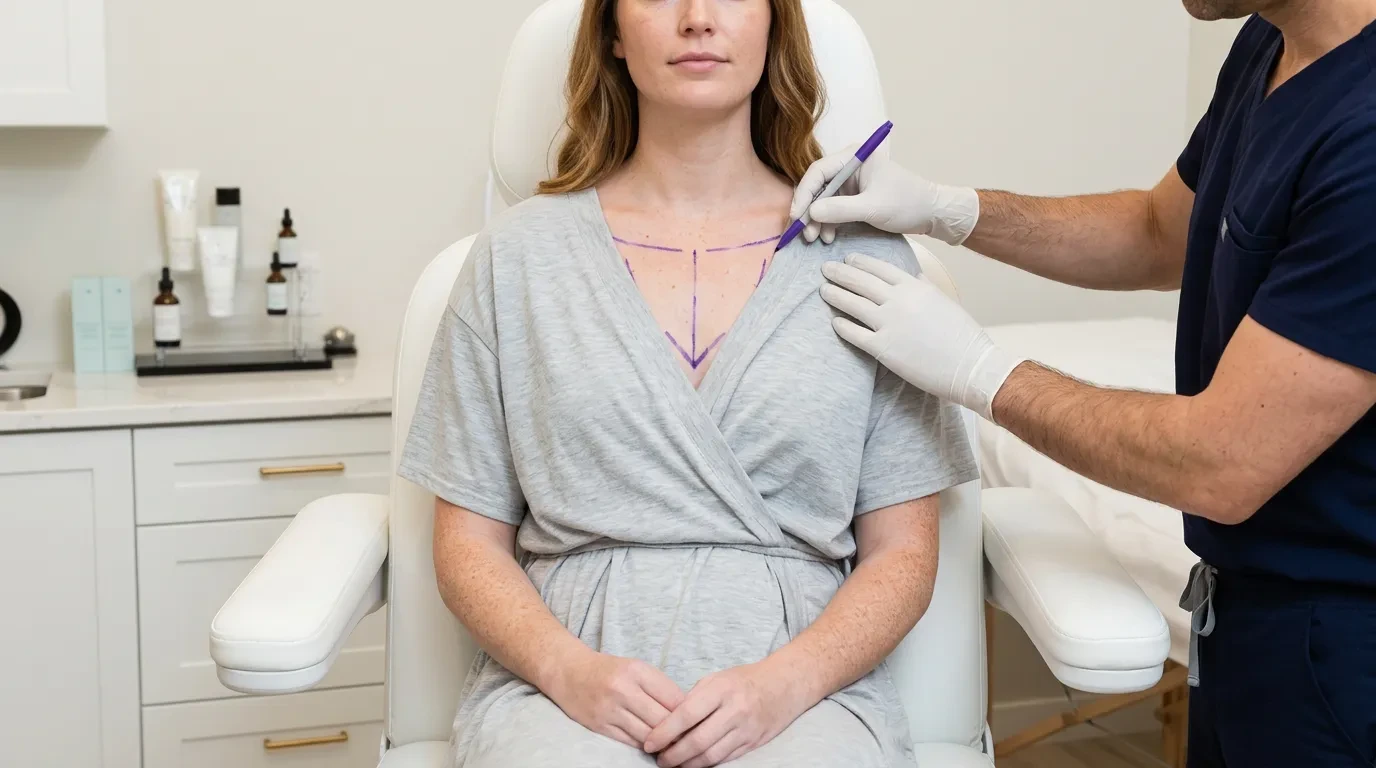
Breast Augmentation
An implant placed to add volume to the breast. It changes size and fullness. It does not raise a breast that has dropped.
Breasts that never developed much, or that emptied after pregnancy or weight loss, in skin that is still firm. If the tissue and nipple sit low and point down, the breast needs a lift instead, and asking for an implant when a lift is required is the most common mistake people make.
An implant supplies the volume that is missing. Size is decided from measurements rather than cup sizes at the consultation. Where a breast has both emptied and dropped, an implant is combined with a lift.
Dr. Tumi performs the surgery. Most patients are back at desk work in about a week, avoid lifting for four to six weeks, and see the implants settle over three to six months. Implants typically last ten to fifteen years or more. The timeline for your case is confirmed at the consultation.
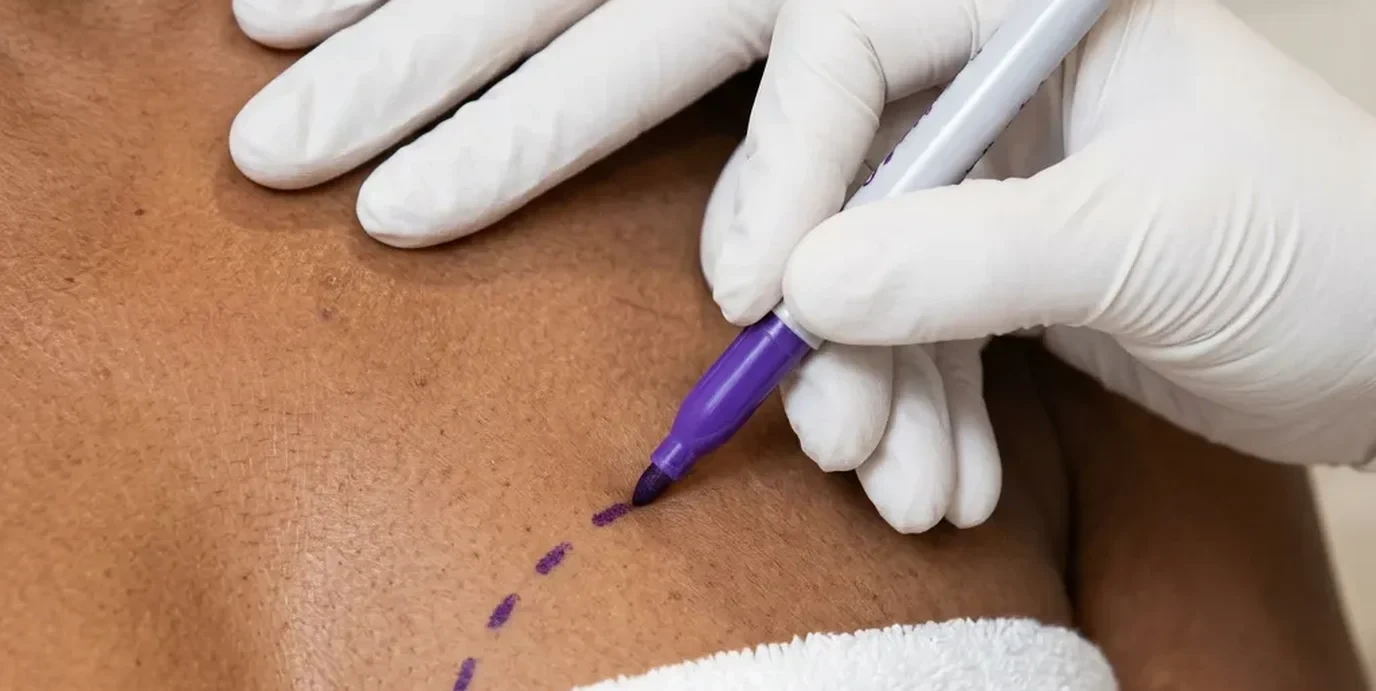
Breast Lift
Removal of excess skin and repositioning of the nipple-areola complex. It restores shape without changing size.
A breast where the skin has stretched and the tissue and nipple sit low, pointing down, with or without enough volume. Where the fullness has gone as well, a lift is combined with an implant.
Excess skin is removed and the nipple-areola complex is moved to sit higher on the breast. An implant is added in the same operation when volume also needs replacing.
Dr. Tumi performs the surgery. Most patients are back at desk work in one to two weeks, wear a support bra for six weeks, and see the final shape at three to six months, with scars that fade over a year. A lift holds for ten years or more at a stable weight.
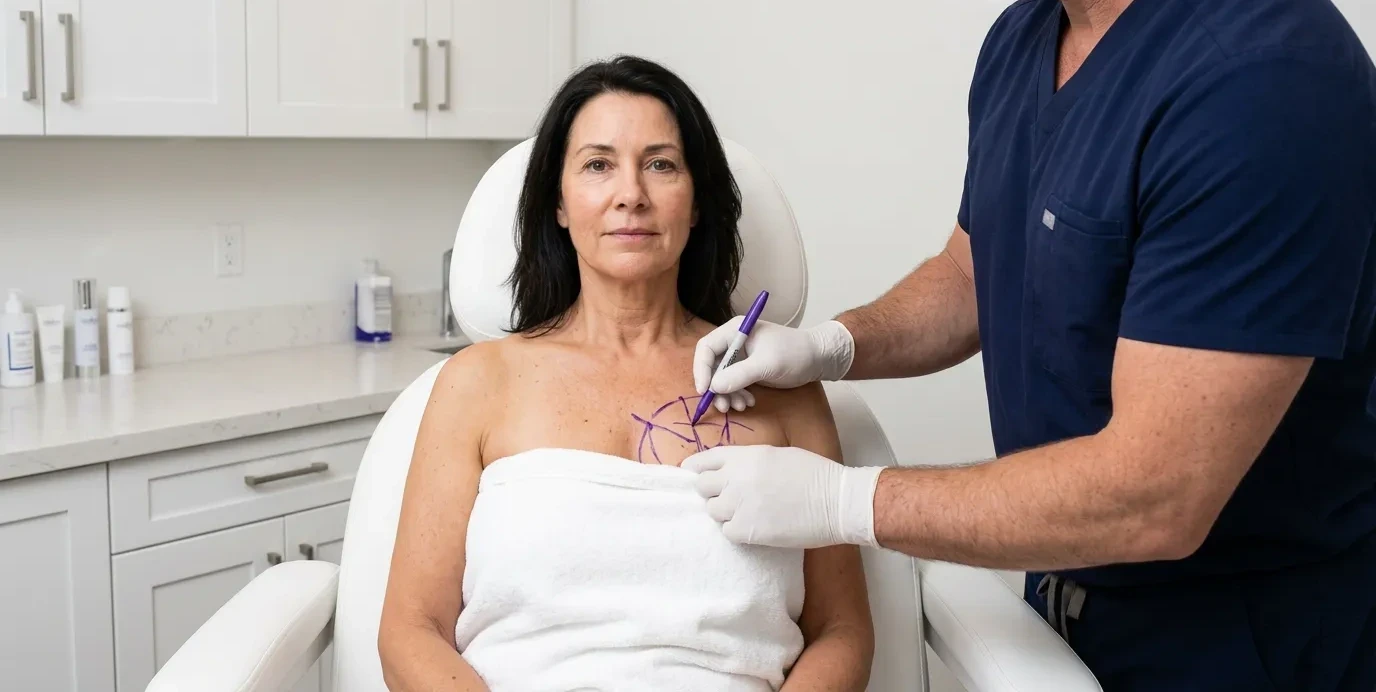
Breast Reduction
Removal of breast tissue and skin to reduce weight and reshape the breast. The breast is lifted at the same time.
Breasts heavy enough to cause neck, shoulder and back strain, bra-strap grooves and rashes in the fold. Taking the weight away takes the strain away with it.
Tissue and skin are removed and the breast is lifted in the same operation, so the shape and the symptoms are addressed together. How much is removed is decided from measurements at the consultation rather than from a target cup size.
Dr. Tumi performs the surgery. Most patients are back at desk work in one to two weeks, wear a support bra for six weeks, and see the final shape at three to six months, with scars that fade over a year. Where a reduction meets medical criteria, coverage is discussed case by case.
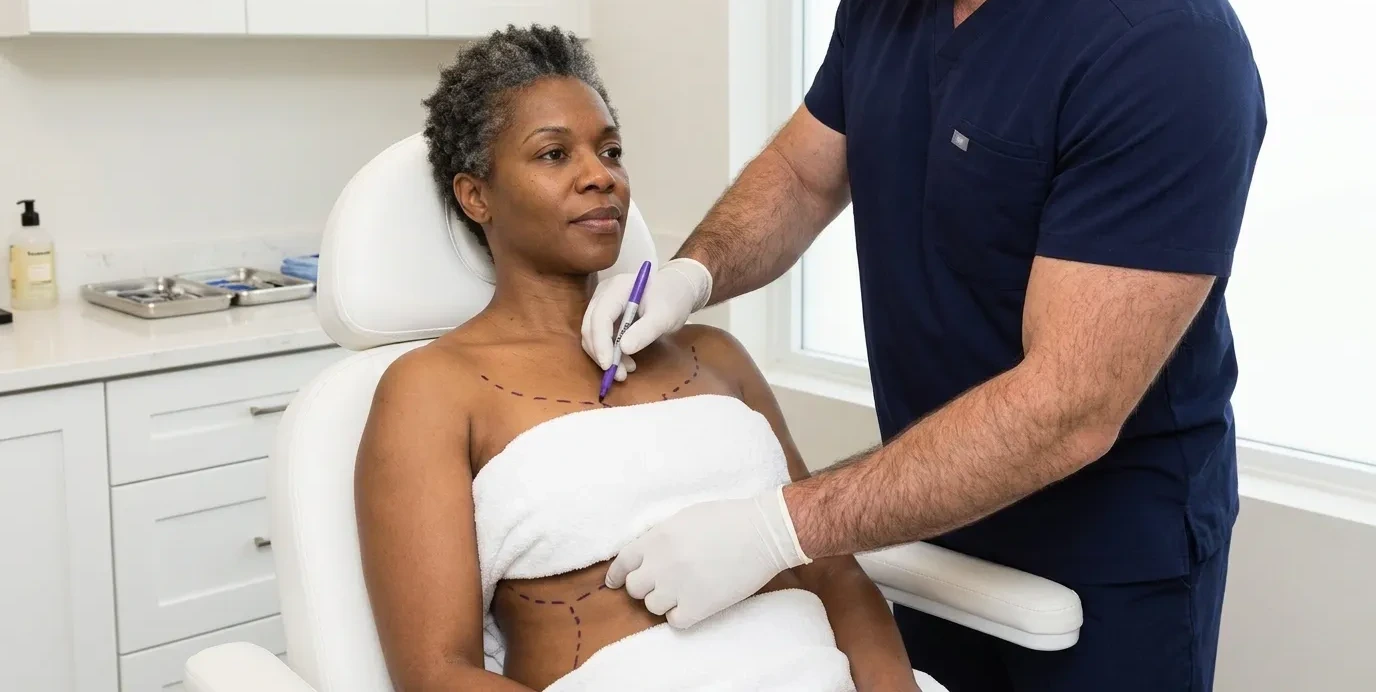
Breast Fat Grafting
A modest increase in breast volume using your own tissue rather than an implant. The change it gives is smaller than an implant's.
Someone with too little volume in skin that is still firm who wants a modest, natural increase and would rather not have an implant. It is not a substitute for a lift where the breast has dropped.
Your own fat is used to add volume to the breast. The increase it gives is modest, which is the main difference between it and an implant.
Dr. Tumi performs the surgery. The timeline for your case is confirmed at the consultation. Fees are quoted at the consultation once Dr. Tumi has seen which operation fits, and you receive the figure in writing.
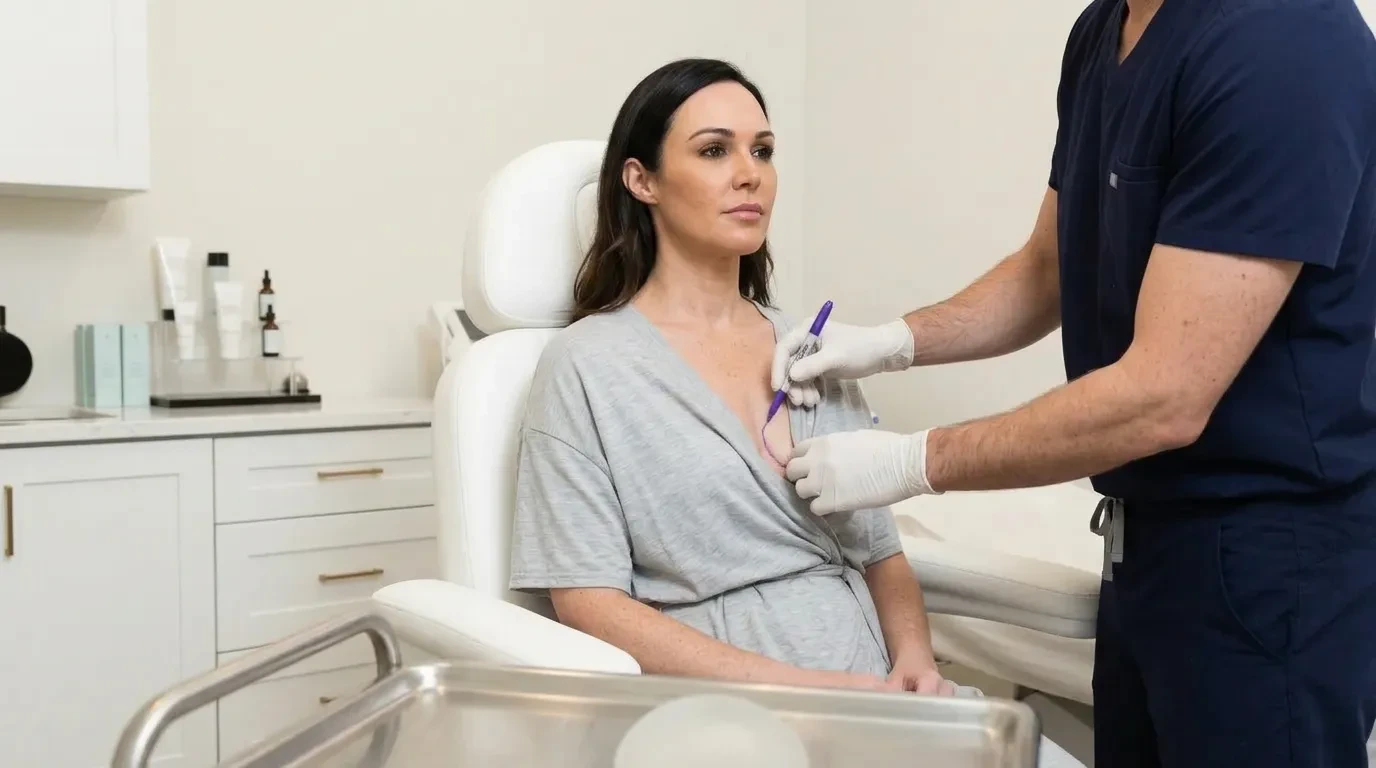
Breast Implant Replacement / Exchange
Exchange of older implants for new ones, or removal of the implants, with a lift where the skin needs one. Which of those applies is decided once Dr. Tumi has seen the implants and the skin around them.
People with existing implants that have hardened, shifted or aged. Implants typically last ten to fifteen years or more, so this is usually a question that arrives years after the first operation.
The old implants are exchanged or removed. A lift is combined with the removal where the skin has stretched around what was there.
Dr. Tumi performs the surgery. The timeline for your case is confirmed at the consultation. Fees are quoted once the operation has been decided, because an exchange, a removal and a removal with a lift are different operations.
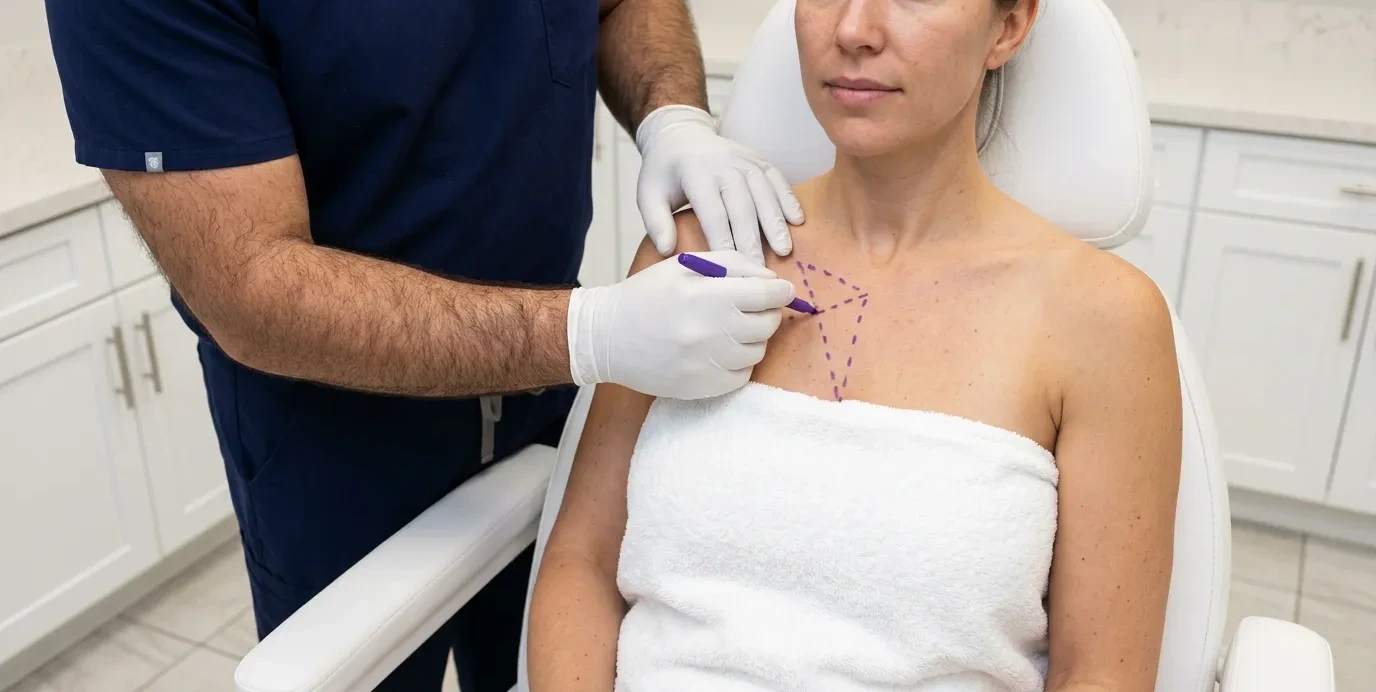
Inverted Nipple / Areola Reduction
Correction of inverted nipples and reduction of large areolae. It addresses the nipple and the areola rather than the size or position of the breast.
People whose concern is the nipple or the areola itself. It also suits people already planning augmentation, a lift or a reduction who want this corrected at the same time.
The correction is done in the same session as other breast surgery, or on its own. Which of those applies is decided at the consultation.
Dr. Tumi performs the surgery. The timeline for your case is confirmed at the consultation, and the fee is quoted there in writing.
Asymmetry is not a separate operation. It is corrected by whichever combination of these brings the two sides closest, decided at the consultation.
The consultation works from measurements rather than cup sizes.

What to expect
After augmentation, most patients are back at desk work in about a week. Lifting is off the table for four to six weeks. The implants then settle over three to six months. A lift or a reduction takes one to two weeks before desk work. A support bra is worn for six weeks. The final shape arrives at three to six months, and the scars fade over the following year. Implants typically last ten to fifteen years or more; a lift or reduction holds for ten years or more at a stable weight. The timeline for your case is confirmed at the consultation. See before and after results
Cost
Fees are quoted at the consultation, once Dr. Tumi has seen which operation fits. Augmentation, a lift, a reduction and their combinations are different operations at different prices, which is why one figure cannot stand for all of them. Where a reduction meets medical criteria, coverage is discussed case by case. You receive the figure in writing. Not covered by OHIP. Financing available through Beautifi, Medicard and Credit Medical.
Financing
Not covered by OHIP. Financing available through Beautifi, Medicard and Credit Medical.
Who provides your care
Surgeon-led care you can verify
You are assessed by Dr. Kamal Tumi, M.D., F.R.C.S.(C), a board-certified plastic surgeon with more than 28 years in practice and over 3,500 surgeries performed, and a consultant plastic surgeon at Royal Victoria Regional Health Centre since 2004. The surgeon who assesses you is the surgeon who operates. Injectable treatment is performed by Dr. Tumi himself. Non-surgical treatment is delivered by our trained clinical team under his direction, including Priscilla Carvalho, medical aesthetician, phlebotomist and skin therapist. Smoking materially affects healing for most procedures, which is why you will be asked about it. His CPSO registration is public and searchable.
“I will not do a surgery on you if you do not need it.”
An assessment and a conversation.
You do not need to arrive knowing which procedure you want. Describing what bothers you is enough. You are not committing to surgery by booking a consultation.
FAQ
About Barrie Plastic Surgery
Yes. He holds an M.D. and is certified by the Royal College of Physicians and Surgeons of Canada as a specialist in plastic surgery. That certification separates a plastic surgeon from a physician who offers cosmetic treatment. He has been a consultant plastic surgeon at Royal Victoria Regional Health Centre since 2004.
In everyday use they are used interchangeably, and both terms describe most of what we do. Strictly, plastic surgery is the recognized surgical specialty, which includes reconstructive work. Cosmetic surgery describes procedures done to change appearance. Dr. Tumi is qualified in the specialty.
It depends on the procedure. Some, including upper eyelid surgery, are done in our own office under local anesthetic. Larger procedures are booked in an operating room, and which setting applies to you is confirmed at your consultation.
Yes. Male patients are a normal part of the practice. Eyelid surgery and gynecomastia are the usual reasons, and skin procedures are common too. ---
Unit 24, 222 Mapleview Drive West in Barrie, just off Highway 400 at the Mapleview exit. Consultations, injectables and the office procedures happen here. Operations that need a general anesthetic are done at Royal Victoria Regional Health Centre, where Dr. Tumi has been a consultant plastic surgeon since 2004.
Dr. Tumi performs facial, breast and body surgery. Skin procedures are part of the practice too: mole removal, skin cancer removal, scar revision. On the non-surgical side he injects the neuromodulators and fillers himself. Laser, CoolSculpting, Morpheus8 and skin treatments are delivered by the clinical team under his direction.
Yes, for anything surgical, and for most non-surgical treatment too. The consultation is an examination and a conversation. Dr. Tumi looks at what is actually causing what you see, tells you what can and cannot be changed, and gives you a written quote afterwards. You are not asked to decide on the day.
Dr. Tumi performs every surgery and every injection himself. The surgeon who assesses you is the surgeon who operates. Laser, CoolSculpting, Morpheus8 and skin treatments are delivered by the clinic's trained clinical staff, under his direction.
Yes. Cosmetic procedures are not covered by OHIP, and we work with three financing providers: Beautifi, Medicard and Credit Medical. Every quote is given in writing at the consultation, so you know the full figure before you decide anything.
Dr. Tumi examines the area himself. He explains what he finds in plain language, including what he would not recommend, and offers the smaller option where one exists. You leave with a written quote and time to think. If nothing surgical is the honest answer, you will be told so.